
Duration Is All You Need
Out of Battery; The Emerging Energy Adequacy Challenge

The value of energy storage is shifting from how much power batteries can deliver to how long they can keep delivering it.
That’s the difference between power capacity (gigawatts, or GW) and energy capacity (gigawatt-hours, or GWh): a 1 GW battery running at full output for four hours delivers 4 GWh of energy. As more storage comes online, short-duration batteries begin competing for the same narrow peak periods. Once those peaks are covered, their marginal capacity contribution begins to decline. The system no longer primarily needs additional power capacity; it needs sustained energy capacity. This represents a shift in systems from capacity-limited to energy-limited.
This shift matters for evaluating which types and durations of storage provide lasting system value, especially as data center demand reshapes load patterns and solar-plus-storage dominates new builds. This evolution in reliability risk builds on broader changes in net load dynamics — including the growing risk of seasonal and multi-day stress events in renewable-heavy systems, which we have examined previously.
Energy Storage’s Value: Historically vs. Today
Historically, most power systems were not energy-limited. Thermal systems powered by resources such as coal, gas, or nuclear were effectively energy-unlimited over reliability time horizons. If a gas plant was needed in hour h, there was little concern about whether it could also run in hour h+1. Fuel supply for thermal generators was not the binding constraint in resource adequacy planning, and capacity needs could often be evaluated non-chronologically.
The primary exception has been hydro-dominated systems. Because hydro resources are constrained by water availability and discharge limits, planners in those regions have long accounted for duration explicitly. For example, the Northwest Power and Conservation Council evaluates resource performance across durations using a five-hour sustained-peaking capacity metric. This reflects the fact that persistence, not just peak output, determines reliability value.
Today, the U.S. capacity mix is shifting toward short-duration lithium-ion storage, now principally four-hour configurations. That design makes sense in early markets, where revenue is driven by ancillary services and short peak events. Nearly all systems experience "needle peaks"—one or two hours where load rises well above surrounding hours—and short-duration batteries are well suited to covering them.
But as deployment scales, the question becomes: what happens after the needle peaks are covered?
Analyzing U.S. Energy Storage Deployment Across 100 Scenarios
To assess this, we analyzed net load (system load after wind and solar generation) across 100 scenarios for the U.S. For each scenario, we calculated the capacity requirement at every discharge duration. In other words, for a given duration, how much dispatchable capacity must persist to satisfy reliability criteria? This produces a duration-ordered capacity requirement curve, showing reliability needs by magnitude and endurance.
This analysis relies on three complementary tools: RIO, our supply-side optimization model that evaluates system reliability chronologically at high spatial and temporal resolution (28 zones and 1,400 timesteps); an AI-enabled research agent that expands the representation of emerging storage and competing technologies within the model; and Ensemble, which explores 100 near-optimal system configurations rather than a single least-cost outcome. Together, these tools allow us to capture technology diversity, reveal the system conditions that encourage or discourage deployment, and identify evolving reliability risk with a level of detail traditional planning approaches often miss.
FIGURE 1: Required dispatchable capacity (GW) by discharge duration (hours) across 100 U.S. Ensemble scenarios (2025-2050).
Two structural features emerge:
1) First, the system requires only a limited quantity of capacity at short durations. There is only so much net load that can be covered by resources discharging for four to six hours.
2) Second, as duration increases, required capacity of any duration declines but remains nonzero across a wide range of persistence intervals. Reliability is not exclusively a four-hour concern.
Parallels to Renewable Deployment
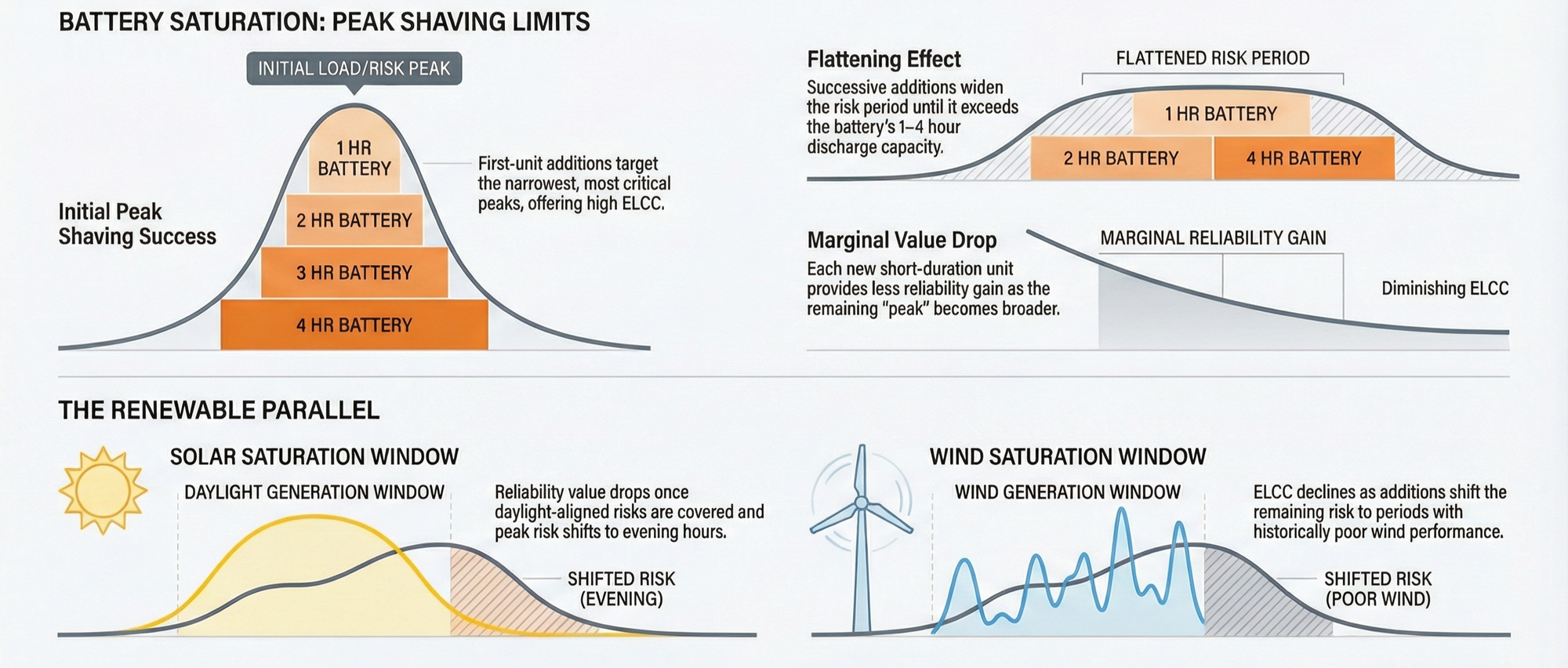
This pattern mirrors what occurred with wind and solar. Early renewable projects displaced the highest-value hours. As penetration increased, new projects were competing to provide capacity value in net load hours which no longer aligned with high renewable output and their marginal capacity value declined (a dynamic oftentimes referred to as ELCC, or effective load-carrying capability).
Short-duration storage follows the same saturation logic. Once short-duration reliability intervals are filled, additional batteries must either accept lower capacity accreditation or increase duration to access the remaining reliability need.
FIGURE 2: Saturation Dynamics in Short-Duration Storage and Renewable Generation
Which Storage Technologies Meet Emerging Duration Needs
We then examined how these duration slices are met economically across the same 100 Ensemble runs. For each discharge interval, we calculated the share of required capacity served by each storage technology from 2025 through 2050. Storage does not serve these slices in isolation—it competes with thermal resources that are effectively duration-unlimited. In Figure 3, opacity reflects how frequently a given technology is selected across scenarios
FIGURE 3: Frequency of Technology Selection by Duration Across 100 Ensemble Scenarios (2025–2050)
A consistent pattern emerges, even though renewable deployment materially affects the scale of capacity needs at each duration. Lithium-ion storage occupies the short-duration segments in virtually every run. Over the long term, capacity needs approaching roughly 16 hours are almost always served by storage resources of some type. Beyond 16 hours, storage is less consistently selected; a range of thermal technologies meets those requirements.
Interestingly, storage becomes economic again at very long durations, above roughly 90 hours. In our modeling, iron-air (high power cost, low energy cost, low efficiency) frequently deploys in the 90–150 hour range. Although the absolute capacity requirement at these durations is smaller than in mid-duration ranges, extended persistence (even at low activity levels due to low roundtrip efficiency) can potentially be competitive against other low utilization resources like peaking thermal power plants.
It is important not to conflate capacity duration requirements with built duration. In some scenarios, lithium-ion moderates its discharge relative to the duration slice it is serving. For example, a four-hour battery contributing to a 12-hour reliability interval effectively receives one-third capacity credit; in a 16-hour interval, that falls to one-quarter. This mirrors emerging accreditation structures: lithium-ion can participate in longer-duration reliability intervals, but with proportionally reduced capacity value per installed gigawatt. In many cases it is built primarily for energy. particularly in solar-heavy systems, and remains economic even with limited capacity credit.
What This Means for Storage Value
The broader implication is structural. As storage penetration rises, system reliability needs migrate outward along the duration axis. The binding constraint shifts from instantaneous discharge capability to sustained energy delivery. Planning framed purely in gigawatts obscures this transition. The relevant metric increasingly becomes gigawatt-hours, because once short-duration scarcity intervals are saturated, persistence is what remains scarce.
The first phase of storage deployment addressed needle peaks. The next phase is governed by the declining marginal capacity value of short-duration assets and by the evolving duration distribution of net load, shaped increasingly by renewables and data centers. Each addition of short-duration capacity accelerates its own obsolescence as a capacity resource. By flattening the peaks it was built to serve, it becomes, in effect, a victim of its own success. As those peaks fade, system risk shifts toward sustained shortfalls and system planners must turn to other resources.
This shift creates an opening for storage technologies seeking to challenge lithium-ion’s dominance in the grid-scale market, as well as for clean firm resources competing against solar-plus-storage products. At the same time, it complicates the idea that load-based flexibility, including datacenter flexibility, can serve as a primary solution to the capacity crunch. Overreliance on short-duration storage and load flexibility to keep pace with rapid load growth may itself introduce reliability risk. In an energy-limited system, endurance rather than peak capacity determines which resources matter.